
As we shift firmly into the second quarter of 2026, the entire gaming industry is vibrating with anticipation. The silence from Rockstar Games has historically been deafening between major announcements, but recent developments, earnings reports, and highly credible insider leaks have finally cracked the dam. The latest GTA 6 news isn’t merely about setting expectations; it is about fundamentally redefining what an open-world action game can be in the modern era of hardware.
The biggest bombshells? A reaffirmed and precise release date of November 19, 2026, for the PlayStation 5 and Xbox Series X/S, alongside staggering technical insights into a newly revamped Rockstar Advanced Game Engine (RAGE 9). Specifically, an AI innovation dubbed “Dialogue Decay” is poised to ensure the streets of Leonida feel more alive than any virtual space ever created.

At SpecVI, our goal is not just to echo the news, but to forensically examine how these technical leaps will translate into real-world performance, hardware requirements, and overall gameplay. Grab your custom diagnostic tools, like our GTA 6 PC Builder, and let’s break down exactly what this massive 2026 development update means for the future of interactive entertainment.
Take-Two’s Fiscal Strategy and the November 19 Target
First, let us address the timeline. In the gaming industry, delays are an accepted reality, particularly for projects boasting astronomical unprecedented budgets. However, as of Take-Two Interactive’s recent entry into their new fiscal year (beginning April 1, 2026), the financial roadmap paints a definitive picture. Take-Two has repeatedly anchored its staggering revenue projections to the Holiday 2026 window.
Multiple industry insiders and financial analysts covering the interactive entertainment sector have now corroborated a targeted rollout date: November 19, 2026.
Why is this specific date so critical, and why should we trust it? November historically represents the highest-grossing period in consumer retail, strategically positioned weeks before Black Friday and the core December holiday rush. By launching in mid-November, Rockstar maximizes its initial sales burst, dominating the global cultural conversation just as consumers finalize their holiday purchasing decisions. Moreover, Take-Two has locked this title into its current fiscal schedule. An alteration at this late stage would severely destabilize investor confidence, a scenario CEO Strauss Zelnick traditionally goes to great lengths to avoid.
For PC gamers, this console-centric launch date brings a different kind of calculation. Historically, Rockstar implements a staggered release, launching on consoles first to capitalize on a massive, unified player base before migrating to the PC ecosystem for a second, highly lucrative launch wave. While a simultaneous PC release remains the dream, historical precedent (GTA V and Red Dead Redemption 2) suggests PC players might be looking at a 2027 window. However, this delay provides crucial time to prepare. The hardware demands of this title are going to be monumental. You can utilize our Can I Run GTA 6? Checker to proactively secure the exact components you will need when the PC port arrives.
The Core of the Beast: The RAGE 9 Engine Overhaul
Releasing a game in late 2026 means Rockstar cannot merely iterate on past successes; they must reinvent their foundational technology. The Rockstar Advanced Game Engine (RAGE) has been the lifeblood of their software since Grand Theft Auto IV. However, the iteration driving GTA 6, colloquially termed RAGE 9, represents a paradigm shift rather than a standard generational upgrade.
Recent leaks from developers adjacent to the project highlight a profound technological ambition. Rockstar is allegedly executing a bottom-up reconstruction of how the engine handles real-world physics, fluid mechanics, global illumination, and spatial audio in dense environments.
Pushing the Boundaries of Physical Simulation
Water is everywhere in Vice City and the broader state of Leonida. We are not just talking about oceans and rivers; we are talking about dynamic weather systems reshaping the terrain, flooding streets during severe storms, and realistic wake generation from boats and aquatic wildlife. RAGE 9 purportedly utilizes a completely revamped fluid dynamics simulation. Instead of static mesh animations or simple texture displacement tricks, water in GTA 6 will behave as a contiguous physical volume. When a speedboat cuts through a canal, the resulting wave will accurately impact floating objects and coastal banks in real-time.
For PC enthusiasts, this level of physical simulation equates to intense CPU and Memory bandwidth utilization. Games generally rely on the CPU to calculate complex physics before sending instructions to the GPU for rendering. RAGE 9’s commitment to hyper-realism implies that players will require top-tier multi-threaded processors to avoid frustrating bottlenecks in densely populated, physics-heavy areas. If you are questioning your CPU’s competency, our GTA 6 GPU Calculator also references CPU bottlenecking variables to give you an accurate picture of your system’s balance.
Volumetric Lighting and True Global Illumination
The neon-soaked aesthetic of Vice City demands a lighting system that goes far beyond baked-in localized specular highlights. RAGE 9 is deeply integrating dynamic Global Illumination (GI) and volumetric atmospheric scattering. While the console versions will likely utilize a highly optimized software-based GI solution, the eventual PC release is widely expected to embrace full hardware-accelerated Path Tracing for those equipped to handle it.
Light will bounce dynamically off colored surfaces. The glaring pink neon of an Ocean Drive hotel will subtly tint the ambient light reflecting off a wet sports car on the street below. This level of visual fidelity is why a robust, future-proofed PC build will be the definitive environment for experiencing the title’s ultimate form. Check our comprehensive guide on the Best PC Build for GTA 6 to see which upcoming GPUs are projected to handle these monstrous ray-tracing demands.
The Revolutionary “Dialogue Decay” AI System
While graphical prowess is expected, the most fascinating leak in the recent wave of GTA 6 news revolves around an internal system referred to as “Dialogue Decay.” This represents a staggering evolution in how Non-Playable Characters (NPCs) behave and interact with the player.
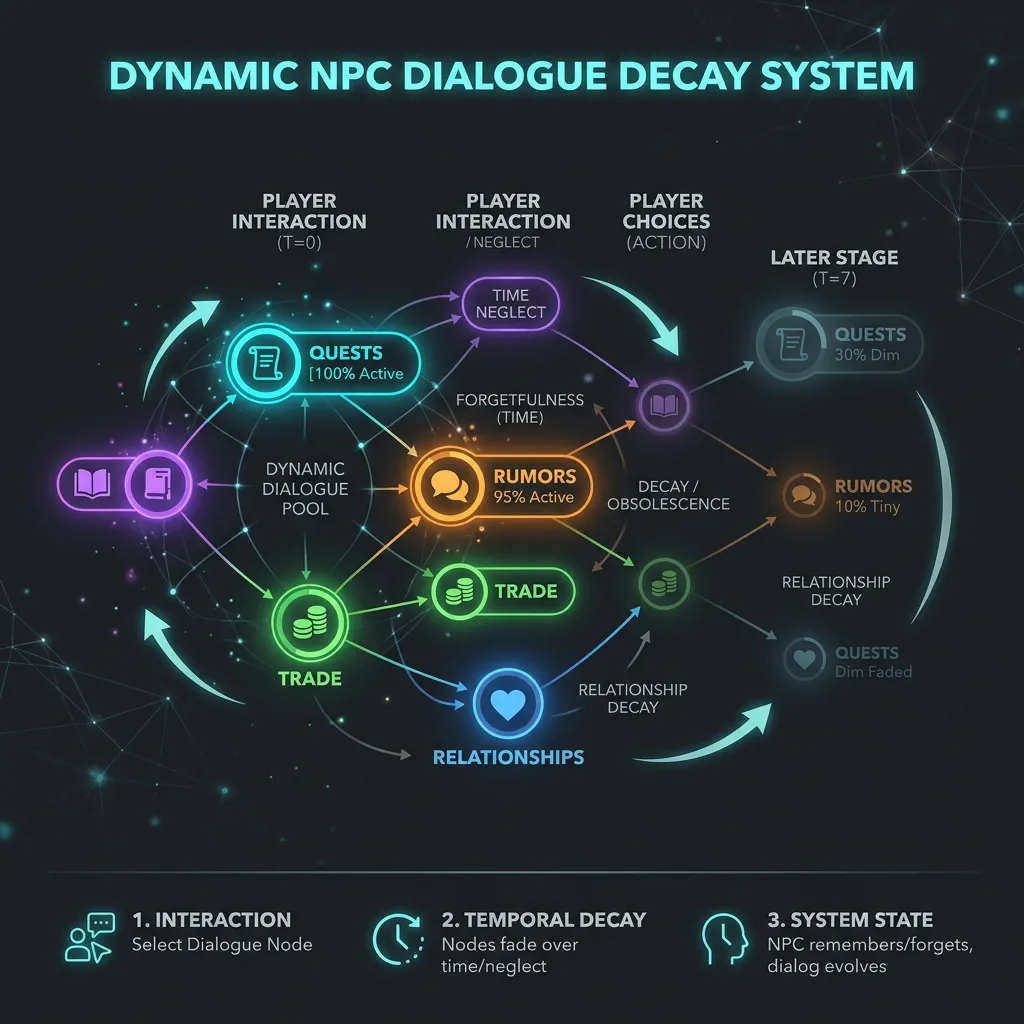
In most open-world games, NPC dialogue operates on a random loop. Walk past the same hot dog vendor three times, and you will likely hear the identical pre-recorded voice line three times. It immediately shatters the immersion and reminds you that you are playing a video game.
Rockstar aims to obliterate this limitation.
What is Dialogue Decay?
According to insider reports, the “Dialogue Decay” system operates as a contextual memory matrix for NPCs and dynamic crowd cohorts. It tracks an intricate web of environmental variables, recent player actions, and chronological passage of time to dynamically alter what an NPC says and how they say it.
For example, if you instigate a massive police shootout in a specific neighborhood, returning to that neighborhood 20 minutes later will not trigger the usual ambient greetings. The NPCs will physically react to your presence based on a persistent memory state. Their dialogue will “decay” from generic greetings into fearful whispers, hostile accusations, or direct references to your recent criminal behavior.
Furthermore, if you frequently interact with a specific recurring vendor or street-level character, their dialogue will progressively evolve. The first encounter might be a formal greeting. The fifth encounter might involve them acknowledging you as a regular. The tenth encounter might involve them referencing an outfit you are wearing or a car you drove previously. Over time, old conversational topics “decay” out of their active memory pool, replaced organically by newer, contextually relevant lines.
The Technical Implications of Advanced AI
This is not a simple feat of writing thousands of lines of dialogue. It requires an immensely complex backend logic system constantly running checks against the player’s history state.
Implementing “Dialogue Decay” alongside a densely populated map means the CPU has to maintain a vast database of background character states simultaneously. Every time you enter a new rendering cell, the engine must instantaneously recall the “memory state” of the relevant NPCs in that zone and load the correct audio banks into active memory.
This AI framework fundamentally alters the hardware requirements. Gamers relying on an aging quad-core processor are going to hit a wall very rapidly. An enormous volume of RAM and lightning-fast NVMe Solid State Drives (SSDs) will no longer be optional luxury components; they will be foundational necessities to stream these dense audio arrays and memory banks without inducing immersion-breaking stutter. The days of installing a Rockstar open-world game on a standard mechanical hard drive are definitively over. Ensure your storage solutions are up to the task by referencing our GTA 6 System Requirements guide.
Marketing Run-Up: Preparing for Trailer 3
With the November 19 release window crystallizing, the marketing timeline for 2026 is becoming highly predictable. Rockstar’s traditional playbook involves maintaining a stoic silence punctuated by massive, internet-breaking media drops.
We are entering the crucial window for the fabled “Trailer 3.” Historically, Rockstar utilizes the final six months before release to shift their marketing focus from establishing the world’s vibe to explaining the game’s core mechanics. We anticipate that a forthcoming trailer will abandon the cinematic montage format and transition into the authoritative “Gameplay Overview” style we saw leading up to Red Dead Redemption 2.
This upcoming trailer is expected to officially unveil the mechanics of the “Dialogue Decay” system, showcasing uninterrupted, dynamic player-NPC interactions. It will also likely provide our first concrete look at the revamped weapon wheel, inventory management, and the dual-protagonist switching mechanic in active combat scenarios.
Fans should also be vigilant around Take-Two’s quarterly earnings calls. While these financial briefings are designed for investors, they often contain explicit forward-looking statements regarding marketing expenditure that directly hint at impending trailer releases or gameplay reveals.
The Economic Context within the Industry
Creating a technological marvel like the RAGE 9 engine and integrating hyper-advanced AI systems like Dialogue Decay is not cheap. The development budget for GTA 6 is widely rumored to exceed $1.5 billion, crossing into unprecedented territory for entertainment media.
This immense financial burden contextualizes the recent discussions regarding the game’s retail pricing. As we covered in our deep dive regarding the GTA 6 price leak, standard AAA gaming cannot sustain these development ambitions at traditional $69.99 price points forever without relying heavily on post-launch monetization. The integration of complex, persistent AI systems like Dialogue Decay justifies a premium product positioning. Rockstar is clearly focused on delivering a generational leap that silences any debate over value proposition.
If you are concerned about whether your current rig can justify the purchase of such a massive, premium title, utilize our GTA 6 GPU Calculator. It is imperative to understand your performance baseline before you invest in the game itself.
How PC Gamers Should Prepare Today
The confirmation of the November 19 console launch and the staggering details surrounding RAGE 9 and Dialogue Decay serve as a powerful reality check. If you have been delaying a PC upgrade, this is the definitive signal that the era of the GTX 10-series and 16-series cards is coming to a close.
To experience the physical water simulation, path-traced global illumination, and dense AI memory matrix without compromise, you must begin building your strategy now.
- Prioritize the CPU: The inclusion of complex NPC tracking and Dialogue Decay indicates heavy multi-threading requirements. Target CPUs like the Intel Core i7-14700K or the AMD Ryzen 7 7800X3D. Open-world logic will choke a weak processor, regardless of your GPU power.
- Vibrant VRAM Needs: High-resolution textures, complex shadow maps, and massive asset streaming in Vice City will decimate 8GB graphics cards. For targeted 1440p or 4K setups, 12GB to 16GB of VRAM will be the new entry-level standard.
- NVMe Storage is Mandatory: Streaming memory states for Dialogue Decay and loading massive texture arrays to avoid pop-in will require bleeding-edge PCIe Gen 4 or Gen 5 NVMe SSDs.
Leverage the GTA 6 PC Builder on SpecVI to map out your upgrade path. It is explicitly designed to handle the RAGE 9 hardware projections and guide you toward a balanced build.
Conclusion: The Dawn of a New Era
The April 2026 update regarding GTA 6 is more than just a timeline confirmation; it is a declaration of intent. The November 19, 2026 launch will herald not merely a new game, but a new standard for atmospheric immersion.
The ambition to overhaul RAGE 9 to accommodate real-time fluid dynamics and true geometric lighting, paired with the awe-inspiring AI leap of the “Dialogue Decay” memory system, demonstrates that Rockstar is determined to defend its crown. They are not just building a bigger map; they are building a fundamentally smarter, more reactive world.
Vice City is preparing to open its gates. It will remember your actions, adapt to your behavior, and respond to your chaos with an intelligence never before seen in gaming. Ensure your hardware is ready to bear witness.